

The Coagulation Cascade: Information Geometry in your blood, stream-lined
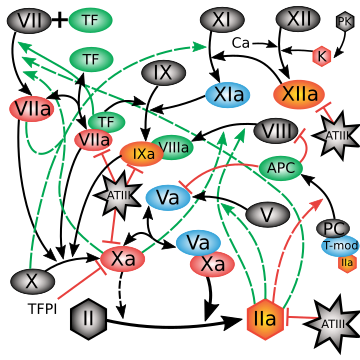
The coagulation cascade is one of the best-characterized signaling systems in human physiology, and also one of the most daunting to model quantitatively. In response to tissue injury, two distinct initiating branches--activation of Factor VII (the extrinsic pathway) and Factor XII (the intrinsic pathway)--converge on the generation of thrombin (Factor IIa), which in turn cleaves fibrinogen to fibrin, forming a blood clot. These processes are mediated by a densely interwoven network of enzymes, cofactors, and feedback loops that span molecular to physiological scales. The biological richness that makes coagulation a central case study in quantitative systems pharmacology (QSP) also makes it a notorious challenge: nonlinear kinetics, overlapping pathways, and therapeutic relevance (as the target of most anticoagulants) mean that models must be both detailed and predictive across a wide range of conditions.
Nayak and colleagues (2015) approached this challenge with a comprehensive mechanistic model that encoded dozens of reactions and parameters derived from the literature, calibrated to thrombin generation profiles. While powerful, the model suffered from the classic problem of "too many knobs": most parameters could not be uniquely identified from available data, and brute-force simulation exposed instability across solvers. This is where information geometry (IG) enters. By analyzing the Fisher Information Matrix (FIM), IG methods revealed a sharply anisotropic parameter space: only a handful of combinations of parameters governed the observable thrombin responses, while the rest resided in flat, sloppy directions with negligible effect. This eigenvalue spectrum (see figure at right) made the dimensionality reduction explicit, providing principled guidance on how to collapse the original network into a minimal yet mechanistically faithful core.
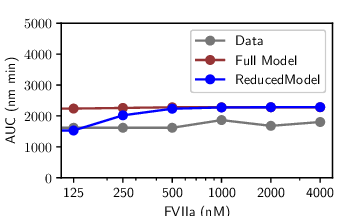
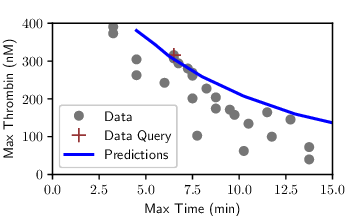
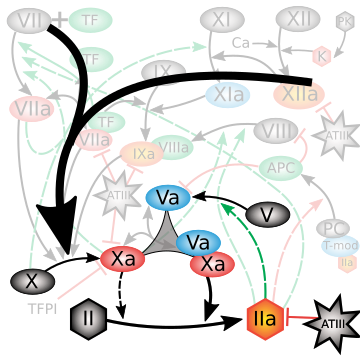
The reduction distilled the cascade into a model with just a small set of parameters and five dynamical variables, with Factor IIa-mediated activation of Factor V emerging as the critical feed-forward loop. Despite the radical compression, the model retained remarkable predictive power: fitting to a single thrombin generation profile enabled it to forecast time to peak, peak level, and area under the curve for 27 other experimental conditions with accuracy rivaling the full model (see figures at left). Equally important, the streamlined equations eliminated solver instabilities and cut computation time by two orders of magnitude, turning an unwieldy benchmark into a nimble predictive tool. In short, the IG-guided reduction did more than simplify; it illuminated the mechanism of adaptation in coagulation and delivered a model that is both interpretable and practical for QSP applications.